The best hydroponics grow system for most first-time indoor growers is a deep water culture (DWC) setup. It is cheap to build, easy to understand, and forgiving enough that you can actually learn from your mistakes without losing an entire crop. That said, DWC is not the right answer for everyone. If you are working in a small space, growing leafy greens on a windowsill, or want a fully automated commercial-style rig, a different system will serve you better. This guide walks through every major system type, maps each one to the grower it actually suits, covers the kits worth buying, and explains everything you need to get running on day one.
Best Hydroponics Grow Systems: Pick the Right Setup

Marcus Holloway
2 Apr 2026
How to choose the best hydroponic grow system for your goals
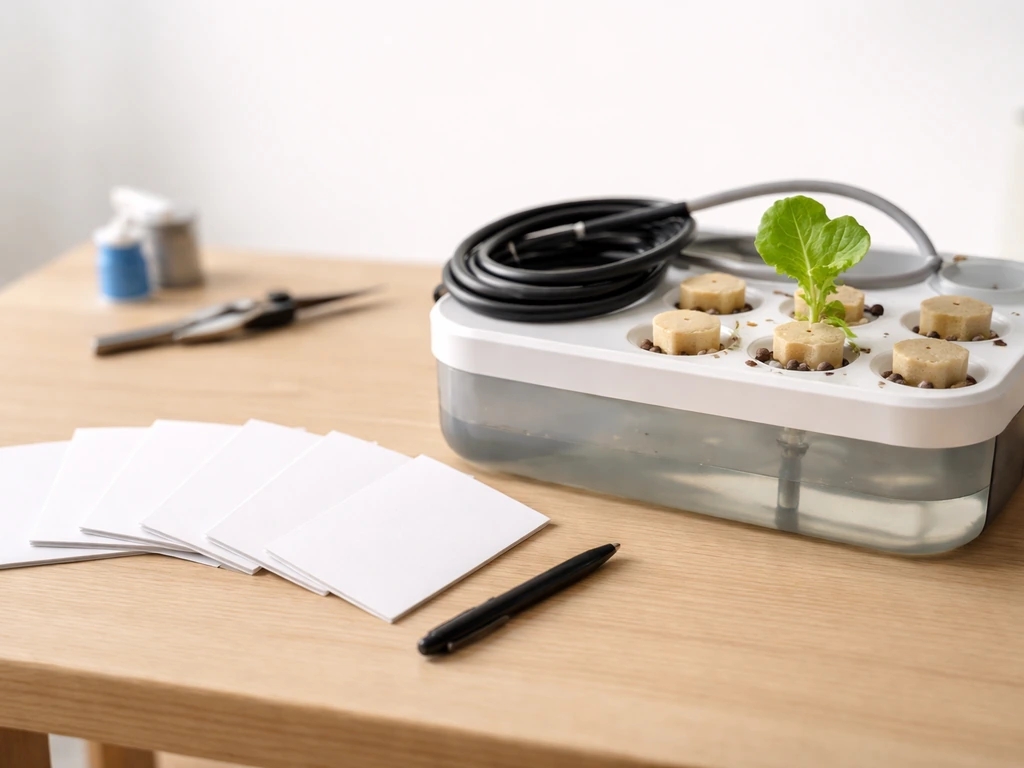
Before you spend a dollar, answer five questions honestly: What are you growing? How much space do you have? What is your budget including ongoing inputs? How experienced are you with plant nutrition and water chemistry? And how much daily hands-on time can you realistically commit? Every system comparison you will ever read online is meaningless unless you filter it through your own answers to those questions.
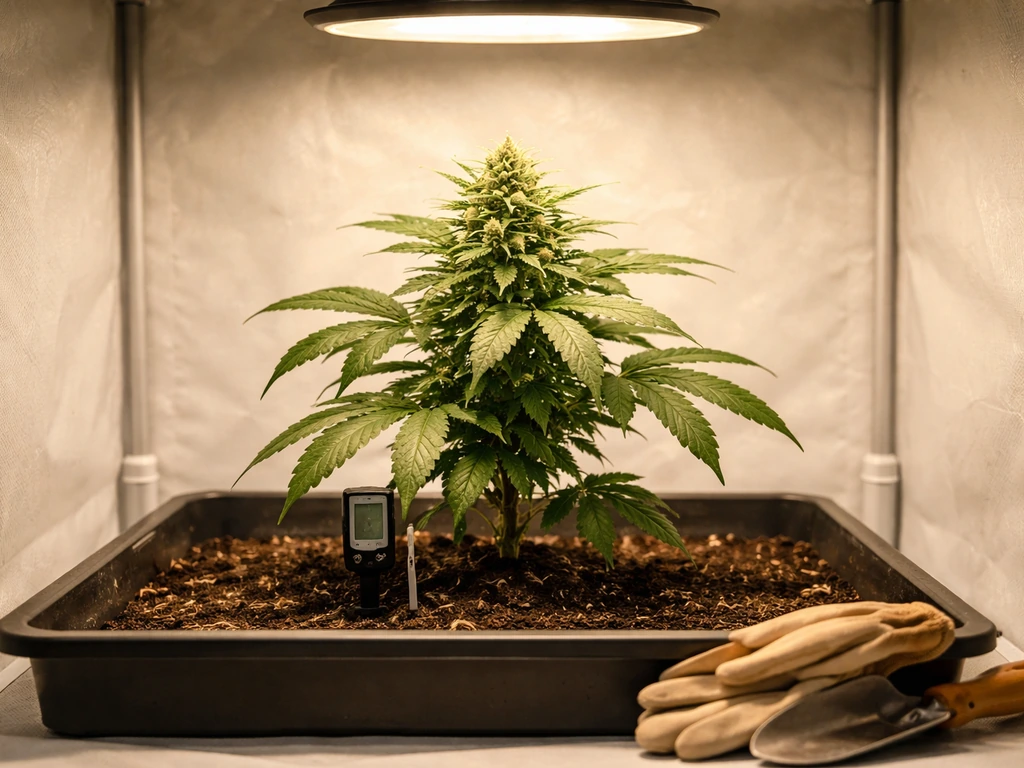
What you are growing matters more than most beginners realize. Fast-growing leafy herbs and greens do well in almost anything, including passive wick systems. Heavy fruiting plants like tomatoes, peppers, and cannabis need robust root zones, high nutrient delivery rates, and strong aeration. If you are focused on finding the best hydroponic grow system for weed specifically, you need to prioritize systems that can handle dense root masses and heavy feeding schedules across distinct growth stages.
Space and budget are linked. A 2x4 ft tent with four DWC buckets is roughly a $200 to $400 entry point for hardware. A recirculating drip or NFT system capable of running twelve to twenty-four sites in a 4x8 ft space can run $500 to $1,500 before lights. Aeroponics, the most technically demanding option, typically costs the most to build and maintain correctly. Budget also needs to account for pH and EC meters, nutrients, grow media, lighting, and environmental controls, not just the reservoir and pump.
Skill level and automation preference go hand in hand. If you have never grown hydroponically before, you want a system that makes the water chemistry obvious when something goes wrong, not one that hides problems until they are catastrophic. Beginners benefit enormously from reading a solid grow guide for hydroponics before committing to a setup, because understanding nutrient cycling, pH drift, and root zone oxygen needs upfront prevents most of the common failures.
Best system types and who each one fits
Deep water culture (DWC)
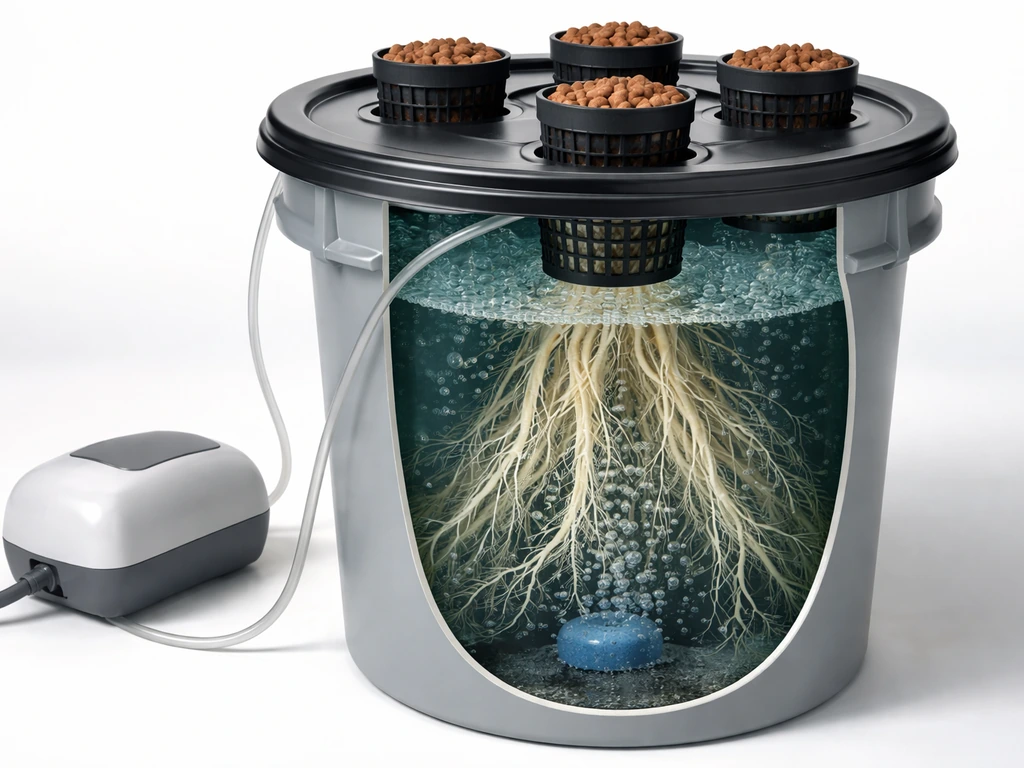
DWC suspends plant roots directly in a reservoir of oxygenated, nutrient-rich solution. An air pump and air stones keep dissolved oxygen levels high enough that roots do not rot. It is the simplest active hydroponic system to build, and the mechanics are transparent: you can see the roots, smell the water, and immediately notice when something is off. DWC scales well for medium to large plants and is particularly popular for cannabis cultivation because it delivers explosive vegetative growth when dialed in. The downside is that reservoir temperature matters a lot. Keep the solution between 65 and 72°F to suppress root pathogens. If your grow room runs hot, you will need a water chiller.
Nutrient film technique (NFT)
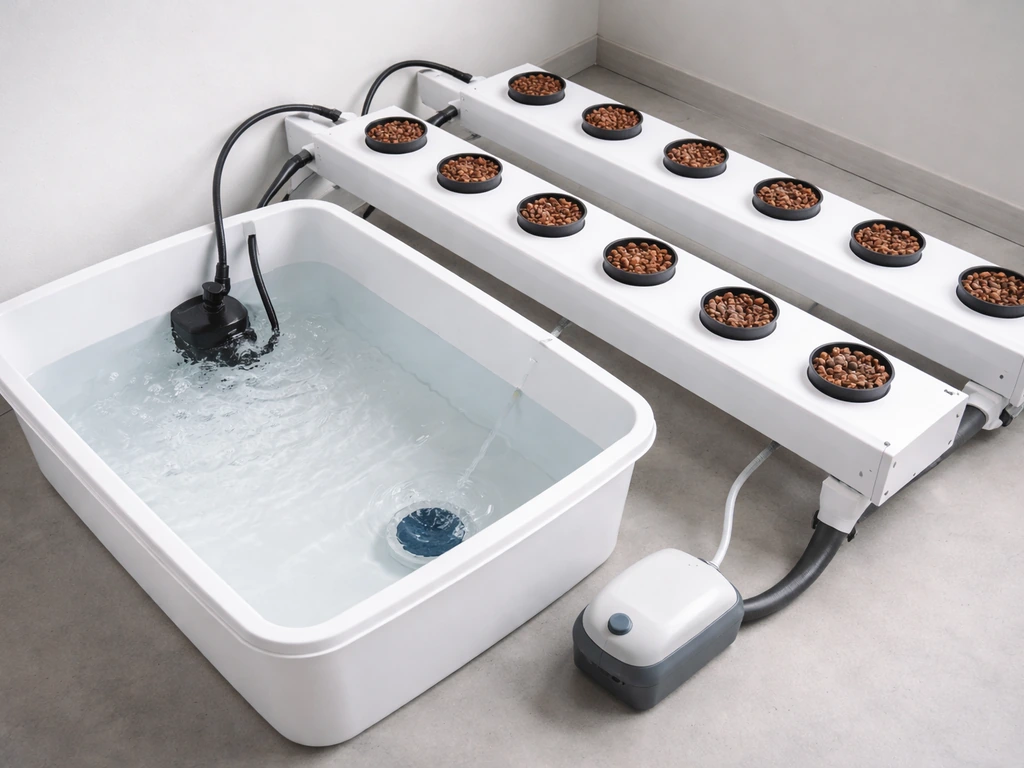
NFT runs a very thin, continuous film of nutrient solution along the bottom of a sloped channel. Roots grow along the channel floor and absorb nutrients from the film while the upper portion of the root mass hangs in air and absorbs oxygen. Channel slope, flow rate, and channel length are all critical and need to be calibrated correctly from the start. NFT works best for lighter crops like lettuce, herbs, and strawberries. It is not ideal for large, heavy fruiting plants because the root mass can clog channels. If the pump stops in an NFT system, roots can dry out in minutes, so redundancy matters.
Drip systems (recirculating and run-to-waste)
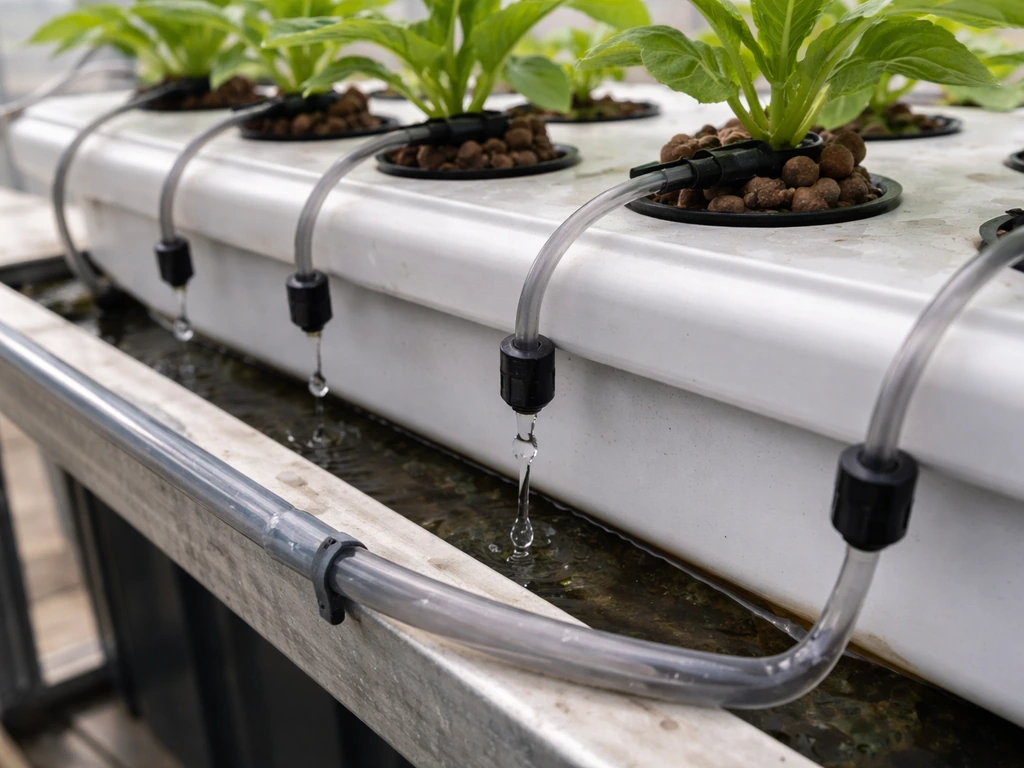
Drip systems deliver nutrient solution directly to the base of each plant through emitters on a timer. Recirculating drip systems collect runoff and return it to the reservoir; run-to-waste systems discard it. Recirculating is more nutrient-efficient but requires more attention to EC drift because unused salts accumulate in the reservoir over time. Run-to-waste is simpler to manage chemically but uses more water and nutrients. Drip is extremely scalable and is the dominant system type in commercial greenhouse production. For home growers, a well-built recirculating drip system handles almost any crop and is a solid choice once you have a basic understanding of EC management.
Ebb and flow (flood and drain)
Ebb and flow systems flood the root tray or grow table with nutrient solution on a timed schedule and then drain it back to a reservoir by gravity. The periodic wet-dry cycle encourages strong root development and works well with a wide variety of grow media. The main risk is disease spread: because all roots share the same flood source, a pathogen introduced into one plant can move quickly through the entire system. Ebb and flow setups suit growers who want flexibility in grow media and container arrangement. They are moderately complex to plumb correctly but are generally reliable once set up.
Wick systems
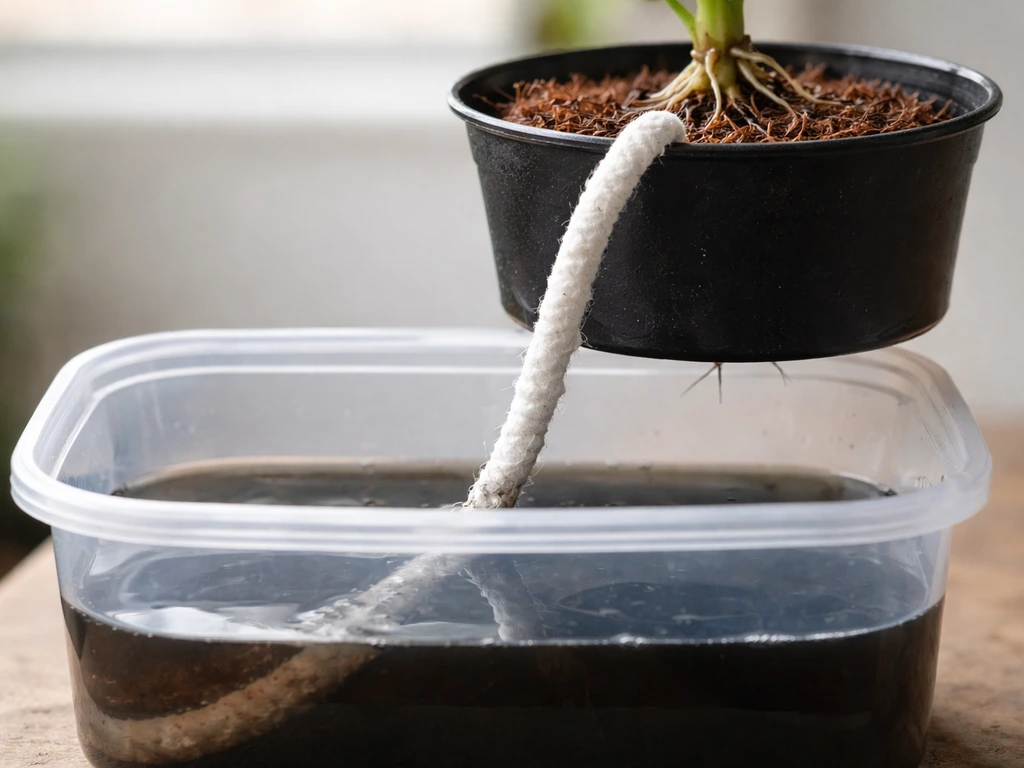
The wick system is the only fully passive option on this list. A wick made of absorbent material (cotton, nylon rope, or felt) draws nutrient solution from a reservoir up into a growing medium by capillary action. No pumps, no timers, no electricity required for the system itself. The obvious limitation is delivery rate: wicks cannot supply nutrients fast enough for large or fast-growing plants. They are genuinely useful for herbs, small leafy greens, and propagation situations. One important note from Illinois Extension is that wick reservoirs need to be opaque or shaded to prevent algae growth, since light and standing nutrient solution are a perfect combination for algae blooms.
Aeroponics
Aeroponics mists bare roots with nutrient solution at timed intervals, delivering maximum oxygen exposure and very fast growth rates. High-pressure aeroponic systems produce fine droplets (under 50 microns) and deliver the fastest growth of any method, but nozzle clogging is a persistent and serious problem. Hard water, mineral buildup, and biofilm inside nozzles can shut down a system quickly. Most experienced growers recommend using reverse osmosis (RO) water or very soft tap water in aeroponic systems specifically to reduce scaling and precipitation inside the nozzle orifices. Aeroponics is a system for experienced growers who are ready to maintain it attentively. If you are just starting out, skip it for now.
| System | Best For | Skill Level | Pump/Timer Required | Key Risk |
|---|---|---|---|---|
| DWC | Medium-large plants, cannabis, beginners | Beginner-Intermediate | Air pump always on | Reservoir temps, root rot |
| NFT | Leafy greens, herbs, strawberries | Intermediate | Yes, both | Pump failure, channel clogging |
| Drip (recirculating) | Almost any crop, scalable setups | Intermediate-Advanced | Yes, both | EC drift, emitter clogging |
| Ebb & Flow | Flexible media/container setups | Intermediate | Yes, both | Pathogen spread, plumbing leaks |
| Wick | Herbs, small greens, propagation | Beginner | None | Slow delivery, algae |
| Aeroponics | Fast growth, experienced growers | Advanced | Yes, high-pressure | Nozzle clogging, pump failure |
Top hydroponic grow kits: what to look for and what they actually include
Grow kits are appealing because they promise everything in one box. In practice, some kits deliver real value and others leave you ordering half the system separately. Here is what a genuinely complete kit should include, and what questions to ask before buying.
A solid kit for NFT-style growing, like the CropKing NFT supply kit, typically includes propagation trays, domes, a heat mat with thermostat, a starter supply of nutrients, a pH control kit, and rockwool cubes. That is a legitimately complete starting package for germination through early vegetative growth. Compare that to budget kits that include a tray and pump but no pH kit, no grow media, and a nutrient sample too small to last more than a week. Always check reservoir size against the number of plant sites: a 5-gallon reservoir split across eight sites is genuinely too small for any plant past the seedling stage.
For anyone who wants to learn how to grow hydroponics from a clean starting point, a DWC kit with a 5-gallon bucket per plant is a more honest starting kit than a multi-site tray system that requires you to understand EC management before you have ever run a system. Single-bucket DWC kits typically include the bucket, lid, air pump, air stone, tubing, net pots, and clay pebbles. What they almost never include: a pH meter, an EC meter, nutrients, or a light. Budget those separately.
- Reservoir size: minimum 5 gallons per large plant site, 1 to 2 gallons per small/herb site
- Number of plant sites and whether the layout fits your space
- Pump quality: submersible pumps for drip/ebb-flow, air pumps for DWC, verify GPH rating
- Air stones and tubing: included or extra? Check tubing diameter matches fittings
- Timers: digital timer for flood cycles or drip intervals (analog timers are less reliable)
- pH and EC kit or meters: if not included, budget $30 to $80 for a reliable combo meter
- Grow media: clay pebbles, rockwool, or coco included or not
- Nutrients: starter packet or enough for a full grow cycle
- Lighting compatibility: does the reservoir lid allow for your light footprint and height adjustment
After unboxing almost any kit, the upgrades most growers end up buying are: a better pH meter (the drop-test kits that come in budget packages are accurate but slow), an EC/TDS meter, a proper nutrient line designed for the crop they are growing, and either a thermometer for the reservoir or a basic inline filter if their tap water is heavily chlorinated or hard.
What you actually need to run any hydro system
Lighting
Indoor hydroponics without adequate light is a waste of water and nutrients. The metric that matters is PPFD (photosynthetic photon flux density, measured in micromoles per square meter per second) and DLI (daily light integral, which is PPFD multiplied by photoperiod in seconds, divided by one million). Seedlings need roughly 100 to 300 µmol/m²/s. Vegetative growth typically targets 400 to 600 µmol/m²/s. Flowering and fruiting crops push into the 600 to 900+ µmol/m²/s range. LED grow lights with full spectrum output are currently the most energy-efficient and heat-manageable option for most home growers.
Nutrients
Hydroponic nutrients need to supply everything the plant normally gets from soil: macronutrients (nitrogen, phosphorus, potassium), secondary nutrients (calcium, magnesium, sulfur), and micronutrients (iron, manganese, zinc, boron, and others). Use nutrients formulated specifically for hydroponics, not soil fertilizers, because the chemistry is different. Two-part and three-part liquid nutrient systems from established brands (General Hydroponics, Athena, Botanicare, FloraMax) are reliable starting points. Follow stage-specific feeding charts and do not try to improvise ratios until you understand how each element affects plant behavior.
pH and EC monitoring
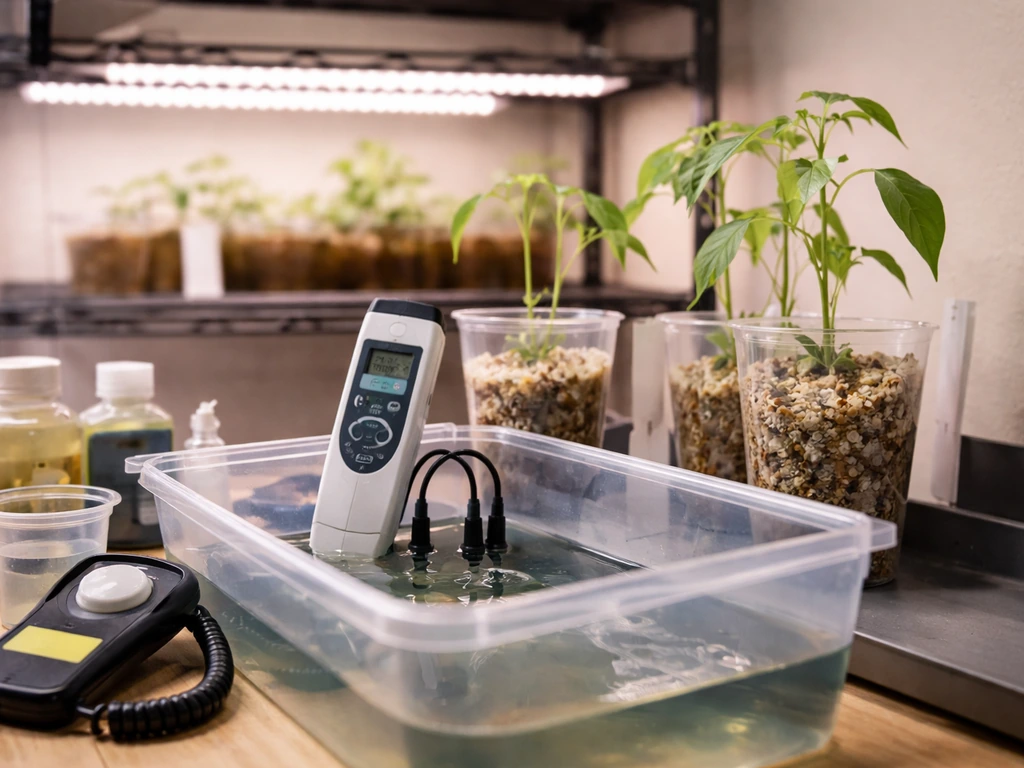
This is the non-negotiable part of hydroponic management. pH controls nutrient availability: most hydroponic crops perform best with reservoir pH held between 5.5 and 6.5, with 5.8 to 6.2 being a common target range. EC (electrical conductivity) tells you the concentration of dissolved salts in your solution, which correlates directly to nutrient strength. Seedlings and early vegetative plants do well at lower EC (around 0.8 to 1.2 mS/cm). Mid-veg pushes to 1.2 to 2.0 mS/cm. Fruiting and flowering stages can go higher, sometimes up to 2.5 to 3.5 mS/cm depending on the crop and conditions. A 5-in-1 water quality tester that measures pH, EC, TDS, salinity, and temperature in one device is a cost-effective way to cover all your monitoring bases from a single instrument.
When adjusting pH up, use a potassium hydroxide-based pH Up solution (like HY-GEN pH Up at 45% concentration). The correct technique is to pre-dilute the required amount in a small separate container of water first, mix it thoroughly, and then add that diluted solution to your reservoir. Pouring concentrated pH Up or Down directly into a reservoir can cause localized pH spikes that stress or burn roots even if the overall reservoir pH reads fine a few minutes later. General Hydroponics also provides indicator sheets to help verify pH adjustment visually during the correction process.
Water quality baseline
Starting water quality affects everything downstream. High starting EC from your tap (above 0.4 to 0.5 mS/cm) means you have less room to work with before hitting plant-stress thresholds. High bicarbonate levels cause upward pH drift. Chloramine (used in many municipal water supplies) does not off-gas like chlorine and can damage beneficial microorganisms and stress plant roots. A basic water analysis using a UMass-style checklist covering pH, EC, alkalinity, hardness, and chloramine content will tell you whether you need RO filtration or conditioning before you start mixing nutrients.
Aeration and temperature
Dissolved oxygen in the root zone is what separates thriving hydroponic plants from sick ones. In DWC, run an air pump sized for at least 1 watt of output per gallon of reservoir volume, with air stones positioned to create full-reservoir circulation, not just a single bubble column. Keep reservoir temperature between 65 and 72°F. Warmer water holds less dissolved oxygen and dramatically increases Pythium (root rot pathogen) activity. Ambient grow room temperature should sit between 70 and 85°F during the light period, with a 5 to 10°F drop during dark periods.
Setting up your system: from empty room to first run
- Set up and level your grow space: hang your light, mount your fan and exhaust, position your tent or room before any plumbing goes in. Fix structural problems before water is involved.
- Assemble the reservoir and plumbing dry: connect all tubing, fittings, and drain lines without water first. Check every connection for fit. Run the pump dry for 30 seconds to confirm flow direction and GPH.
- Fill the reservoir with conditioned water: if using tap water with chloramine, use a conditioning agent or RO water. Fill to the target operating level before adding nutrients.
- Mix nutrients into the reservoir: add nutrients per the feeding chart for your growth stage, starting at the lower end of the recommended dose. Add Part A fully, stir, then add Part B. Never premix concentrated Part A and Part B together before diluting.
- Check and adjust EC: measure EC after mixing. Adjust nutrient dose up or down to hit your target EC for the current stage.
- Check and adjust pH: measure pH and adjust using pre-diluted pH Up or pH Down solution. Add small amounts, wait 5 minutes, re-measure, repeat until stable.
- Calibrate your pH meter before first use: use standard buffer solutions at pH 4.0 and pH 7.0 to perform a two-point calibration. This step is non-negotiable for accurate readings.
- Run a clean water test cycle: before adding plants, run the system for 24 hours. Check for leaks, confirm pumps and timers are cycling correctly, and re-check pH and EC after the test run.
- Transplant seedlings or clones: place rooted starts into net pots with grow media. For DWC, set water level so roots are just touching or slightly above the solution surface initially.
- Log your starting conditions: write down reservoir volume, EC, pH, water temperature, and date. This is your baseline for tracking drift and making adjustments.
Keeping it running: maintenance and troubleshooting
Root rot
Root rot is caused by water molds, most commonly Pythium species. Symptoms are brown or slimy roots (healthy roots are white), a foul sulfur-like odor from the reservoir, wilting despite adequate water, and yellowing leaves. The cause is almost always one or more of: reservoir temperature above 72°F, insufficient dissolved oxygen, light leaking into the reservoir, or contaminated tools or water. Early intervention with 3% hydrogen peroxide (roughly 3 ml per gallon as a starting dose, added to the reservoir) can halt mild infections by oxidizing the pathogen. For serious infections, a full system flush, reservoir sterilization, and root trim may be necessary. Products like Biosafe ZeroTol HC are used by some growers for pathogen and algae control in hydroponic and aquaponic systems.
Algae
Algae needs two things: light and nutrients. Your reservoir and any exposed solution surfaces provide the nutrients, so controlling light is the primary prevention strategy. All reservoirs should be completely opaque. Net pot holes in lids should be covered when not occupied, and any tubing that runs through lit areas should be opaque or wrapped. Green reservoir water with a film on the surface means light is getting in somewhere. Beyond aesthetics, algae competes for dissolved oxygen and nutrients and creates biofilm that harbors pathogens. Drain, scrub with a dilute bleach or hydrogen peroxide solution, rinse thoroughly, and identify the light leak before refilling.
Clogged emitters and nozzles
Drip emitters clog from mineral scale, root intrusion, and biofilm. Aeroponic nozzles are even more sensitive: small orifice sizes mean even minor precipitation inside the nozzle can reduce or block flow completely. Check emitters weekly by observing flow during a watering cycle. Remove and soak clogged emitters in white vinegar or a citric acid solution for 30 minutes to dissolve mineral scale. For aeroponic nozzles, the most effective prevention is starting with RO or very soft water and keeping nutrient solution pH stable to minimize mineral precipitation inside the orifice.
Pump and aeration failures
A failed air pump in a DWC system can kill roots within hours in warm conditions. A failed water pump in an NFT or drip system can dry roots out in minutes. Keep a spare air pump on hand if you are running DWC, because they are inexpensive and the cost of losing a plant to pump failure is always higher. For recirculating systems, set a timer alert or check-in reminder so you notice if a pump stops mid-cycle. Inspect tubing monthly for kinks, algae buildup, and loose fittings.
Nutrient imbalances
Nutrient imbalances show up in leaves before they cause serious damage if you are paying attention. Yellowing starting from older (lower) leaves suggests nitrogen deficiency. Yellowing between veins on newer growth (with green veins remaining) suggests iron or manganese deficiency, often a pH problem rather than a nutrient absence. Purple or red stems and dark leaf coloring can indicate phosphorus stress, especially in cold conditions. Before adding more of any nutrient, always check pH first. Most apparent deficiencies in hydroponic systems are actually pH-lockout issues where nutrients are present but unavailable because the solution is outside the optimal range. If you are comparing hydroponic performance against soil-grown plants and trying to decide which system suits your crop long-term, understanding the full hydroponic vs soil grow trade-offs will help you make the right call.
Routine maintenance schedule
- Daily: check pH and EC, top off with pH-adjusted plain water if level dropped (topping off with nutrient solution causes EC to creep up over time)
- Every 3 to 7 days: inspect roots, check pump and timer function, look for pests or algae
- Weekly: check reservoir temperature, inspect emitters or air stones for blockage or scaling
- Every 1 to 2 weeks: full reservoir change in small systems (5 to 20 gallon), or partial drain-and-refill in larger systems to prevent salt buildup
- Between grows: full system flush, sterilization with hydrogen peroxide or dilute bleach solution, rinse thoroughly before refilling
Narrowing your choice and what to buy next
If you are a beginner growing one to four medium-to-large plants indoors, start with DWC. Buy a 5-gallon bucket kit per plant, a reliable air pump, a digital pH/EC combo meter, and a two or three-part hydroponic nutrient system. Read through a resource specifically built for hydroponics grow systems for beginners to make sure you understand the basics before you fill that first reservoir.
If you are growing leafy greens or herbs and want a compact, low-maintenance solution, a small NFT channel kit or a wick-based setup works well and keeps complexity low. If you are an intermediate grower ready to scale up or automate, a recirculating drip system with a central reservoir, an inline filter, and a digital timer controller gives you the most flexibility for different crop types and plant counts.
Whichever system you choose, the fundamentals are the same: calibrate your meters, dial in pH and EC before plants go in, protect your reservoir from light and heat, and keep a backup pump. Hydroponics rewards consistent attention far more than expensive equipment. If you want a deep dive into the full process from nutrients to harvest timing, working through a comprehensive hydroponic grow book is still one of the best investments you can make before your first run.
FAQ
How can I tell if my tap water quality will ruin my hydroponic setup before I buy a system?
If you do not have a full water analysis, do a practical “starting point” test: measure your tap EC (or TDS) and reservoir pH after mixing nutrients, then compare how quickly pH drifts over 24 hours. If your tap EC is already near or above about 0.4 to 0.5 mS/cm, you will usually be forced into higher-stress nutrient ranges unless you dilute or condition with RO.
How do I calibrate pH and EC meters so I do not waste weeks debugging nutrient problems?
For DWC and other active systems, accuracy matters more than brand. A common mistake is relying on a cheap pH/EC meter calibration solution too old or not fresh, which can lead to chasing “phantom” deficiencies. Calibrate on the same day you plan to mix and adjust, and verify that probes are stored in proper storage solution, not dry.
What is the fastest way to confirm that my pH management technique is actually working?
Start with a plain buffer check: aim for the pH you want at nutrient mix time, then recheck after 30 to 60 minutes and again the next morning. If pH jumps rapidly, you likely have high alkalinity or an unstable adjustment routine (like adding concentrated pH Up/Down directly). Pre-diluting corrections in a separate container usually prevents those localized spikes.
If my plants look like they are burning, how do I know whether to lower EC or fix pH first?
Do not judge “overfeeding” only by leaf color, because pH lockout can cause nutrient-starvation symptoms while EC looks fine. A better decision rule is: measure pH first, then compare EC to your current growth stage range, and only then decide whether to reduce nutrients. If pH is out of range, correct pH before changing EC targets.
Can I run hydroponics with minimal automation, and what are the non-negotiable safeguards?
Yes, but only with careful controls. Even “simple” setups can fail when reservoir temperature climbs, light leaks, or oxygen drops. A common approach is pairing DWC with a thermometer and a small circulation strategy, then using light-proof reservoirs and an air pump sized with headroom so a tired pump does not become the weak link.
Will a system that works for lettuce automatically work for fruiting plants like tomatoes or peppers?
No, because the correct system depends on your crop mass and flow needs. NFT channels and wick reservoirs can handle lighter plants, but heavy fruiting crops can outgrow them due to root congestion or delivery limits. If you are planning tomatoes, peppers, or dense cannabis growth, prioritize systems with strong nutrient delivery and aeration, like DWC or well-designed recirculating drip with filtration.
Do I need to change nutrient solution more often if I use recirculating drip or NFT?
Yes, and it changes what “best” means. If you run recirculating drip or NFT, nutrients and salts build up differently than in drain-to-waste. Plan for periodic reservoir changes or dilution, and install at least an inline filter, then inspect for biofilm and mineral scale weekly to avoid sudden flow failures.
How can I tell if my DWC oxygenation is strong enough, beyond just “I have an air pump”?
A common mistake is treating oxygen like a set-and-forget number. In DWC, you should size the air pump for reservoir volume and keep air stones producing full-reservoir circulation, then verify that bubbling is uniform across the bucket. If you lose aeration even briefly, root conditions can deteriorate quickly in warm rooms.
If I use RO water, will my plants still get enough calcium and magnesium?
If you are using RO or very soft water, mineral correction is still important, especially for calcium and magnesium needs as plants grow. Do not rely on generic “soft water” alone, instead follow a hydroponic nutrient line that includes the proper secondary nutrients or supplement based on your EC and stage.
What should I do if my reservoir turns green or grows a film, and what not to do?
If you get algae, first treat it as a light-control problem, not a nutrient problem. Make every reservoir opaque, cover unused net pot openings, and ensure tubing is shielded where it passes through lit areas. Then drain, scrub, rinse thoroughly, and only after you fix the light leak should you refill.
What are the most common equipment failures, and how can I design my setup to survive them?
Yes. Many beginners lose crops from an assumption that equipment failure is rare. For DWC, keep a spare air pump available and consider an emergency plan for power interruptions (for example, a backup power source). For NFT or drip, a timer or watchdog alarm helps because roots can dry out in minutes if flow stops.
What is the simplest decision tree for diagnosing deficiencies in hydroponics?
Most hydroponic nutrient issues are misdiagnosed as “missing nutrients” when the true cause is pH lockout or reservoir drift. A practical approach is: check pH, then check EC, then observe whether symptoms match stage-specific ranges. Only after that should you adjust feeding rates, since adding nutrients while pH is wrong can worsen the problem.