The correct FloraGro dosage for vegetative growth starts at around 2.5–5 ml per gallon (roughly 0.5–1 teaspoon) for beginners or sensitive plants, and scales up to 15 ml per gallon (about 3 teaspoons) for aggressive vegetative feeding. Where you land within that range depends on your growing method, your water's baseline EC, and what your plants are actually telling you. This guide walks through every variable so you can dial in the right amount today, whether you're growing in soil or running a hydroponic system.
FloraGrow Dosage Guide: Measure Mix and Feed Steps

Marcus Holloway
16 Apr 2026
What FloraGro actually is and when it belongs in your feed schedule
FloraGro is one part of General Hydroponics' three-part FloraSeries system, alongside FloraMicro and FloraBloom. Its guaranteed analysis is 2% total nitrogen (split as 0.25% ammoniacal and 1.75% nitrate), 1% available phosphate (P2O5), 6% soluble potash (K2O), and 0.5% water-soluble magnesium. That high potassium-to-nitrogen profile is designed specifically for "structural and foliar growth," meaning it supports the root system, internodal spacing, and canopy development that happen during the vegetative stage.
You use FloraGro heavily from early veg through late veg, then taper it down as you transition to bloom. During bloom, FloraBloom takes over the primary role, while FloraGro drops to a maintenance dose or zero depending on the specific feedchart week. If you jump straight to a bloom-heavy mix without FloraGro during veg, you'll often see spindly, underdeveloped plants that don't have the structural framework to support heavy flowering later. Think of FloraGro as the scaffolding you build before putting up walls.
One important note: FloraGro never works alone. The FloraSeries is a three-part system by design. Always mix FloraMicro into fresh water first and stir, then add FloraGro, then FloraBloom. Never combine FloraMicro with FloraGro or FloraBloom in their undiluted, concentrated forms or you'll trigger a calcium-sulfate reaction that locks nutrients out of solution. If you're newer to multi-part nutrients, learning how to grow with FloraFlex is a good parallel read for understanding how modular nutrient systems work in practice.
Soil vs. hydroponics: dosage isn't the same for both
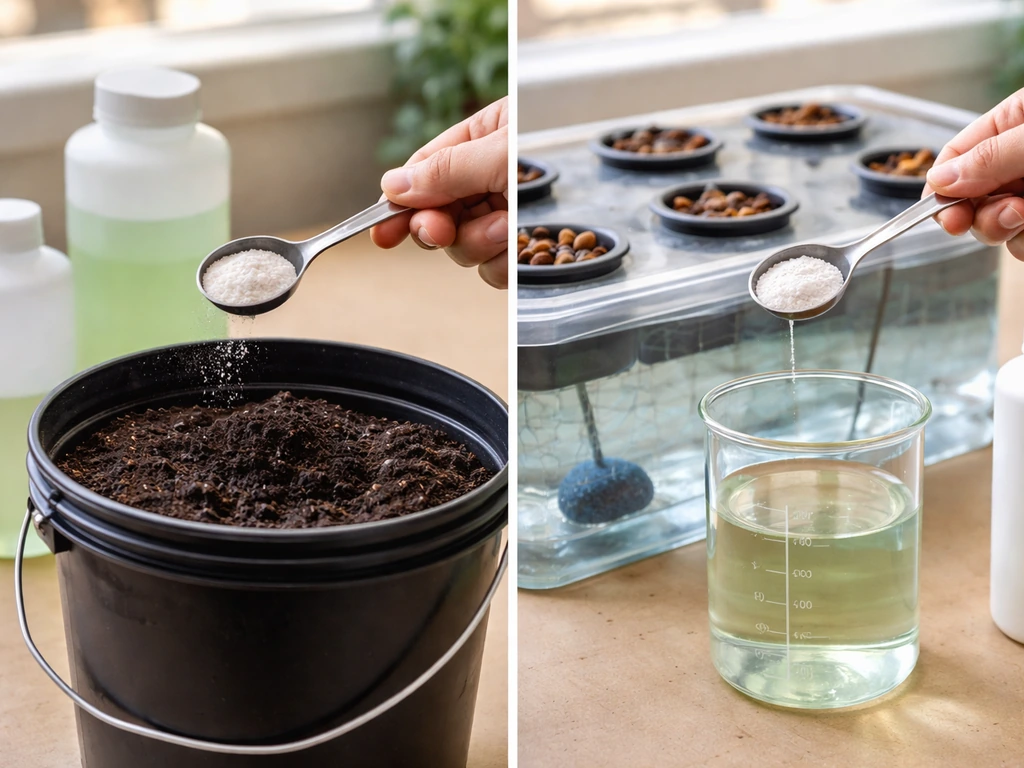
This is the question most growers skip over, and it causes more problems than almost anything else. Soil and hydroponics require meaningfully different FloraGro concentrations, and applying hydro-strength doses to a soil grow is one of the fastest ways to salt-stress your plants.
| Factor | Soil | Hydroponics |
|---|---|---|
| Typical FloraGro dose (veg) | 1–2 tsp/gal (5–10 ml/gal) | 1–3 tsp/gal (5–15 ml/gal) |
| Starting EC target (early veg) | 0.8–1.2 mS/cm | 0.8–1.4 mS/cm |
| Late veg EC target | 1.2–1.6 mS/cm | 1.4–2.0 mS/cm |
| Watering/feeding frequency | Water between feedings; feed every 2–3 waterings | Every watering (recirculating or drain-to-waste) |
| Buffer for mistakes | High — soil holds and buffers nutrients | Low — imbalances show within 24–48 hours |
| Flush strategy | Flush with plain pH'd water every 2–4 weeks | Change reservoir every 7–10 days |
In soil, the growing medium itself holds nutrients between waterings, which means mineral salts accumulate over time. You feed less often and at slightly lower concentrations to account for that buffering. In hydroponics, nutrients are in constant contact with roots and get consumed or drift in concentration daily, so you run a full-strength solution every time and monitor EC more closely. If you're running an inert medium like coco coir, treat it like hydroponics, not soil, because coco has almost no buffering capacity.
For soil growers who also want to understand how CO2 enrichment interacts with nutrient uptake at higher feed rates, it's worth reading about how to grow with CO2, since elevated CO2 environments can support higher feeding concentrations without burning plants.
How to calculate your actual FloraGro dose
The label gives you ranges in teaspoons per gallon and milliliters per 100 liters. For practical home-grow math, stick with ml per gallon or ml per liter. The conversion the label gives you is 5 ml = 1 teaspoon and 3.785 liters = 1 gallon. That makes the mental math easy.
Here's the dosing table from General Hydroponics' Growth Stage Feedchart, translated into usable numbers across the three feed-strength programs:
| Growth Stage | Feed Program | FloraGro (ml/gal) | Target EC (mS/cm) | PPM (500 scale) |
|---|---|---|---|---|
| Seedlings / Clones | All | 1.5–2.5 ml/gal | 0.6–0.8 | 300–400 |
| Early Veg (Light) | Light | 3.4 ml/gal | 0.9–1.1 | 450–550 |
| Early Veg (Aggressive) | Aggressive | 4.8 ml/gal | 1.3–1.5 | 650–750 |
| Late Veg (Light) | Light | 5.6 ml/gal | 1.2–1.6 | 600–800 |
| Late Veg (Medium) | Medium | ~7–8 ml/gal | 1.6–2.0 | 800–1000 |
| Aggressive Veg | Aggressive | ~15 ml/gal (3 tsp) | 1.7–2.1 | 850–1050 |
For a standard 5-gallon reservoir running a medium veg program, you're looking at roughly 35–40 ml of FloraGro (around 7–8 ml/gal multiplied by 5). For a 20-gallon recirculating system at aggressive veg rates, that's closer to 300 ml per reservoir fill. Always measure with a graduated syringe or measuring cup, not freehand pours. The label-listed conversion of 2.5 ml = 0.5 teaspoon is useful if you're mixing small batches by hand.
If you're mixing at the 100-liter scale (common in larger recirculating setups), use the ml/100L column on the label. For early veg at a medium feed rate, that's roughly 185–200 ml of FloraGro per 100 liters. At 26.4 gallons per 100 liters, that tracks closely with the per-gallon numbers above.
Mixing order, application schedule, and how to ramp up properly

Mix order every single time
- Start with fresh, pH-adjusted water (before adding nutrients)
- Add FloraMicro first, stir well
- Add FloraGro, stir well
- Add FloraBloom last (even at zero dose during early veg, it's good practice to stay consistent)
- Check and adjust final pH to 5.5–6.5 (hydro) or 6.0–7.0 (soil)
- Check EC/PPM against your target range before applying
Shake the FloraGro bottle well before every use. This matters more than most people realize, especially if the bottle has been sitting for a few weeks. Settling can change the concentration of what you're actually measuring out.
Application schedule and ramping
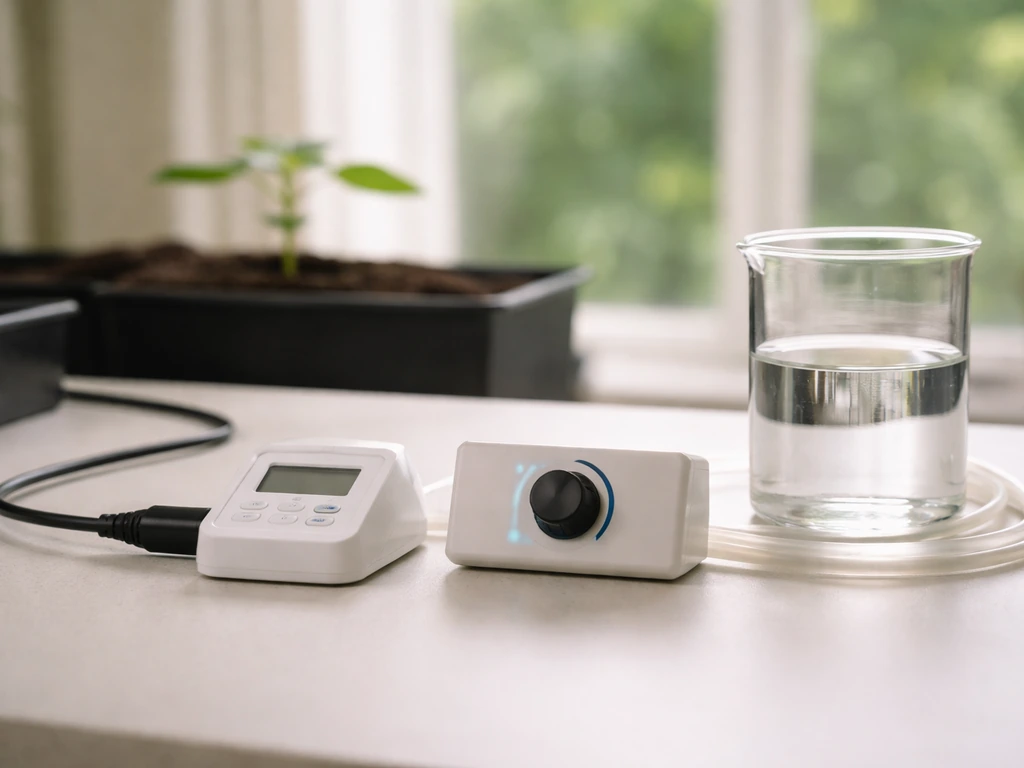
Start every new grow at the low end of the dosage range. Week 1 for seedlings or freshly rooted clones should be EC 0.6–0.8 mS/cm. Don't push to full vegetative strength until the plant has established a visible root system and is actively putting out new growth. From week 2 onward, increase EC by about 0.2–0.3 mS/cm per week until you reach your target for the veg phase. The weekly feedchart from General Hydroponics shows exactly this ramp: Week 1 at EC 0.6–0.8, Week 3 jumping to EC 1.7–2.1 for aggressive programs. That's a gradual climb, not a jump.
For soil growers, feed on every second or third watering during early veg, and only increase to every watering if the plant is growing aggressively and showing no signs of salt stress. For hydro, replace the reservoir every 7–10 days and top off with fresh water between changes. Don't just keep adding concentrated nutrients to a depleted reservoir: that causes nutrient drift, where the ratios of elements shift as plants consume some faster than others.
Note that the same principles apply whether you're running FloraGro alone or pairing it alongside a carbohydrate supplement. If you want to understand how flora grow carbo dosage fits into an advanced feed program, that's worth mapping out before your next reservoir fill.
Using EC and PPM to dial in your dose
EC (electrical conductivity) is your most reliable tool for managing FloraGro strength. It measures the total dissolved salts in your solution, which gives you a proxy for overall nutrient concentration. A reliable EC meter is non-negotiable if you're running hydroponics, and strongly recommended for soil grows too.
The PPM conversion factor matters a lot here. If your meter uses the 500 scale (NaCl standard), 1.0 mS/cm equals approximately 500 ppm. If it uses the 700 scale, 1.0 mS/cm equals approximately 700 ppm. General Hydroponics' feedcharts reference the 500-scale PPM, so if your meter uses 700:1, your actual ppm readings will read higher for the same EC. When in doubt, use EC as your primary reference, since it's universal. For early veg, target 0.9–1.1 mS/cm for a light program and 1.3–1.6 mS/cm for an aggressive one.
For hydro systems, measure EC at the reservoir before feeding and check it again 24 hours later. If EC drops quickly (more than 0.2–0.3 mS/cm per day), your plants are feeding hard and you may be able to push concentration slightly. If EC rises or holds steady, plants aren't consuming much, which could mean pH is off, roots are stressed, or the plant is in a slower growth phase. Top off with plain water first; don't just dump in more nutrients.
For soil, the best proxy is runoff EC. Water with your nutrient solution until you get 10–20% runoff from the bottom of the pot, then measure that runoff's EC. If it's more than 0.5 mS/cm above your feed EC, salts are accumulating and you need a plain-water flush. If runoff EC is significantly lower than your input EC, the soil may be depleted and ready for a slightly stronger feed. This runoff-reading method is one of the most practical ways to avoid the guesswork that causes most soil overfeeding problems.
It's also worth pointing out that some plants are more sensitive to nutrient concentration than others. If you're growing low-light or slow-growing aquatic or carpeting plants in an enriched environment, similar principles apply. For example, Monte Carlo can grow without CO2, but nutrient concentration still needs to stay conservative in lower-tech setups to avoid algae and melt.
Reading your plants: underfeeding vs. overfeeding
Your plants will tell you whether your FloraGro dose is right, and learning to read these signals accurately will save you more time than any spreadsheet. The tricky part is that some symptoms overlap, and misdiagnosing underfeeding as overfeeding (or vice versa) makes things worse.
Signs of underfeeding
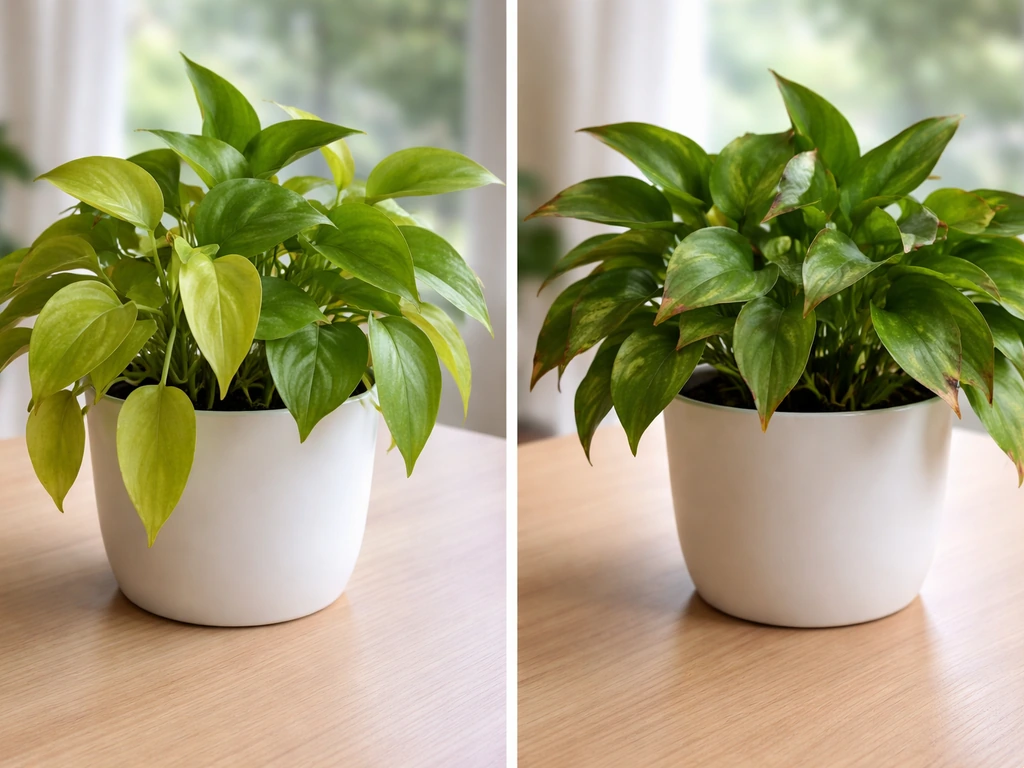
- Pale green or yellowing leaves, starting from older (lower) growth and moving upward
- Slow internodal growth and smaller-than-expected leaf size
- Thin, wiry stems that don't firm up even under good light
- Leaves that look washed out despite adequate light and pH
- EC readings consistently dropping fast in the reservoir (plants consuming nutrients rapidly)
Signs of overfeeding
- Leaf tip burn: brown or crispy edges starting at the tips of leaves, especially newer growth
- Leaf curl or clawing, particularly on the edges or downward cupping
- Dark green leaves that look almost waxy or glossy (nitrogen toxicity)
- White crusty salt deposits on the surface of growing media or pot edges
- Wilting despite adequate watering (salt stress disrupting water uptake)
- Runoff EC significantly higher than input EC
The first response to overfeeding signs should always be reducing dose by 25–30% and flushing with plain pH'd water, not adding more nutrients. The label specifically states to reduce nutrient strength if plants show signs of stress, or in very hot, bright, or dry environments where nutrient uptake can become unbalanced. Overfeeding in high-VPD environments is a very common mistake in summer grows.
If you see deficiency-like symptoms but you're already running moderate-to-high EC, check pH first before increasing dose. Nutrient lockout from pH drift is far more common than true deficiency, and it presents with almost identical symptoms. Get pH into the 5.5–6.5 range (hydro) or 6.0–7.0 (soil) before changing your dosage.
Storage, safety, and preventing salt buildup
FloraGro is a concentrated liquid fertilizer, so storage and handling matter both for safety and product quality. Store the bottle away from freezing temperatures and out of direct sunlight. If the product crystallizes (which can happen in cold storage), mix the entire contents with an equal volume of hot water and use double the amount called for in your feed mix to compensate for the dilution. Don't just warm the bottle and hope for the best: re-homogenizing the whole bottle ensures your dose measurements are accurate again.
For hydroponic systems, salt buildup in lines, emitters, and growing media is a slow but real problem with any concentrated nutrient like FloraGro. Keep your nutrient solution temperature below 75°F (24°C): warmer water holds less oxygen and encourages microbial growth and salt precipitation. Keep the solution aerated at all times using an air stone or circulation pump. Change the reservoir completely every 7–10 days rather than just topping off, because partial top-offs cause nutrient ratios to drift as plants selectively consume different elements.
For salt and mineral buildup that has already accumulated in lines, media, or pots, General Hydroponics' FloraKleen is specifically formulated to break down and flush fertilizer residue from hydroponic systems, growing media, and potting soils. Running a FloraKleen flush at the end of a grow cycle, or any time you notice significant salt deposits or a dramatic EC rise without increased feeding, can clear the system before problems compound. For soil growers, a plain water flush every 2–4 weeks during heavy feeding periods achieves a similar result without dedicated products.
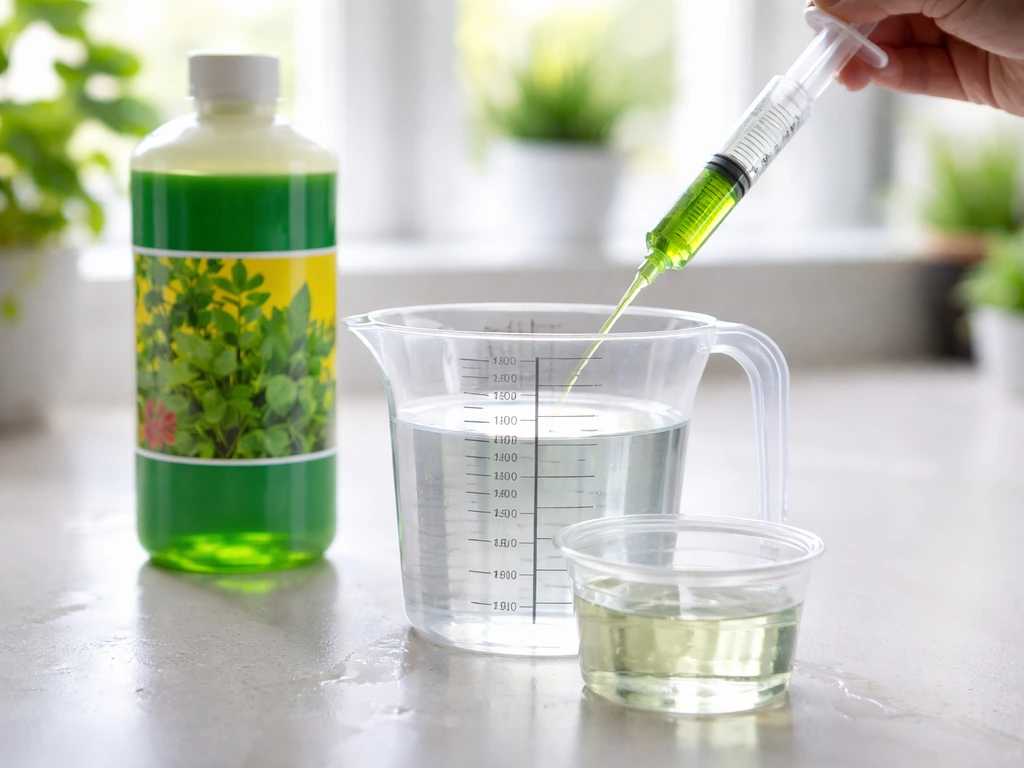
When measuring FloraGro, use a dedicated graduated syringe or measuring cup, not a kitchen spoon. Spoons vary significantly in actual volume, and at the concentrations you're working with (5–15 ml per gallon), even a 1 ml error per gallon compounds significantly across a full reservoir fill. Rinse your measuring equipment after each use to prevent cross-contamination between FloraMicro, FloraGro, and FloraBloom: mixing them in undiluted concentrated form, even on a measuring spoon, causes the same precipitation reaction as adding them out of order.
Your next steps right now
If you're starting a new veg cycle today, here's the practical sequence: Mix fresh water, add FloraMicro first, then FloraGro at 3.4 ml/gal for a light early-veg program or 4.8 ml/gal for an aggressive one. Check EC (target 0.9–1.5 mS/cm depending on program), adjust pH to 5.5–6.5, and apply. After 24–48 hours, observe new growth tips and leaf color. Every 5–7 days, increase dose by one incremental step toward your target EC ceiling for the veg stage (up to 1.6–2.1 mS/cm at peak veg). Flush or change the reservoir before transitioning to bloom, and begin tapering FloraGro down as you ramp FloraBloom up.
If you're troubleshooting an existing grow, check EC and pH in that order before touching your dosage. Most problems that look like wrong dosage are actually pH problems in disguise. If EC and pH are both in range and you still see symptoms, then adjust dose by 25% in the appropriate direction and wait 3–5 days to observe the response before making another change. Plants don't respond instantly to nutrient adjustments, and making multiple changes at once makes it impossible to know what actually fixed the problem.
FAQ
Do I measure FloraGro in ml first, or do I “set EC” directly and skip the ml math?
You can set by EC, but still mix by recipe order and confirm your EC. Use the ml calculations to get close, then fine-tune with EC after mixing and pH adjustment. For hydro, recheck EC after 24 hours before changing dosage, because nutrients keep moving into solution and plants continue uptake, so “instant EC” readings can be misleading.
If my FloraGro bottle got slightly frozen, can I still use it without changing the dose?
If it crystallized or the product separated, assume concentration is no longer uniform. The safest approach is to fully re-homogenize the whole bottle by mixing it with equal hot water first, then compensate during mixing by using double the amount called for (or follow your label’s crystallization guidance). Avoid partial “thaws” where only the top portion is mixed.
What should I do if EC is on target but plants look stressed anyway?
Check pH and then symptom patterns. If pH is drifting, the plant can lock out nutrients even when EC looks correct. For hydro, target pH roughly 5.5–6.5 and verify using the same calibration routine for your meter. Also confirm root zone oxygenation (aeration, temperature below about 75°F/24°C), because low oxygen can mimic nutrient issues.
How do I tell underfeeding from overfeeding when symptoms look similar?
Use the “data first” rule. If your EC is high and symptoms resemble burn or tip damage, cut dose 25–30% and flush with pH’d water. If EC is not elevated or runoff EC is low relative to input, increase gradually. Then wait 3–5 days after each change, since real nutrient-related responses are delayed.
Can I use FloraGro in coco coir like soil, or should I treat it like hydro?
Treat coco like hydro for dosing and flushing frequency. Coco has much less buffering than typical soil, so salts and ratios shift quickly. Expect to monitor reservoir EC more closely and plan regular reservoir changes or strong flushes, rather than feeding infrequently at lower concentrations like you would in soil.
My soil runoff EC is higher than my input EC. How much should I flush and how often?
If runoff EC is more than about 0.5 mS/cm above your feed EC, it indicates accumulation. Flush with plain pH’d water until runoff drops toward your target, then reduce future dose or feeding frequency. In heavy feeders, doing a plain-water flush every 2–4 weeks can prevent repeated salt buildup from turning into lockout.
Should I top off a hydro reservoir with more FloraGro when EC drops?
Prefer not to. Topping off tends to shift nutrient ratios as plants consume elements at different rates, and it can create gradual imbalance even if EC seems corrected. Instead, replace the reservoir on your schedule (about every 7–10 days) and top off only with plain water between full changes if needed to keep volume stable.
What temperature should my nutrient solution be for best FloraGro performance?
Keep solution temperature below about 75°F (24°C). Warmer water holds less oxygen and increases microbial growth and precipitation risk, which can reduce nutrient availability and cause EC to behave inconsistently. Use room temperature or cooler water and verify your chiller or reservoir location during hot weather.
How much can I adjust FloraGro if EC is slightly off target?
Make a single change and wait. If you need a correction, adjust by about 25% and then observe for 3–5 days before changing again. For minor deviations, many growers do better with slow EC ramps rather than big jumps, because plant uptake and symptom expression lag behind mixing.
Is it safe to mix FloraGro with a carbohydrate supplement or other additives in the same container?
It depends on compatibility, but as a rule do not combine concentrates in undiluted form. Keep the FloraSeries mixing order (Micro in first, then FloraGro, then FloraBloom) for the nutrient trio, and add other products only after the base nutrients are fully mixed and diluted as instructed by their labels. If you add supplements early and undiluted, you increase the chance of precipitation or ratio drift.
Can I use kitchen spoons to measure FloraGro if I’m only making a small batch?
Avoid it. Spoon volume varies and small ml errors can add up quickly at typical growth dosing ranges. Use a dedicated graduated syringe or measuring cup for consistent dosing, and rinse thoroughly after each nutrient to reduce cross-contamination risks between parts.
How do I handle pH when starting a new veg mix for FloraGro?
Adjust pH after all nutrients are mixed into water, not before. Then verify again if possible after 24 hours, especially in hydro systems, because pH can drift as nutrients equilibrate. If you adjust pH repeatedly during the first day, do it carefully, since frequent acid or base changes can compound stress.
Should I increase FloraGro dose during heat waves or high VPD?
Be cautious. Hot and dry conditions can make uptake unbalanced, a common driver of apparent “overfeeding” even at moderate EC. If temperatures rise, consider maintaining or slightly reducing dose and rely on EC and runoff or reservoir trends to guide changes rather than pushing strength automatically.