Plagron Terra Grow is a soil-based base nutrient for the vegetative (grow) phase, and the correct starting dosage is 5 mL per litre of water (roughly 20 mL per gallon) as a maximum. In practice you work up to that over the first few weeks, starting much lower, while targeting an EC of around 0.6 mS/cm in early weeks and climbing to 2.0 mS/cm at peak veg. pH for your feed water should sit in the 5.5 to 6.5 range. That is the core answer, but how you get there depends on your grow style, your tap water, and which week you are in. Here is exactly how to dial it in.
Terra Grow Dosage Guide: Soil and Hydro Mix Steps
Marcus Holloway
28 May 2026
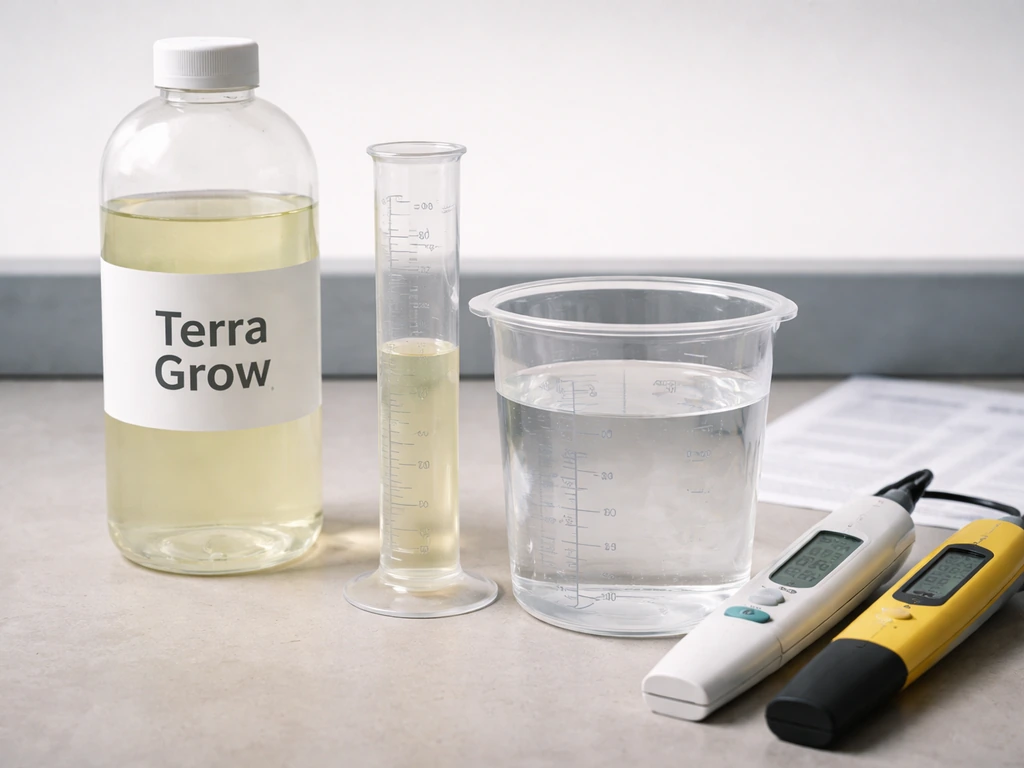
Which "Terra Grow" bottle are you actually holding?
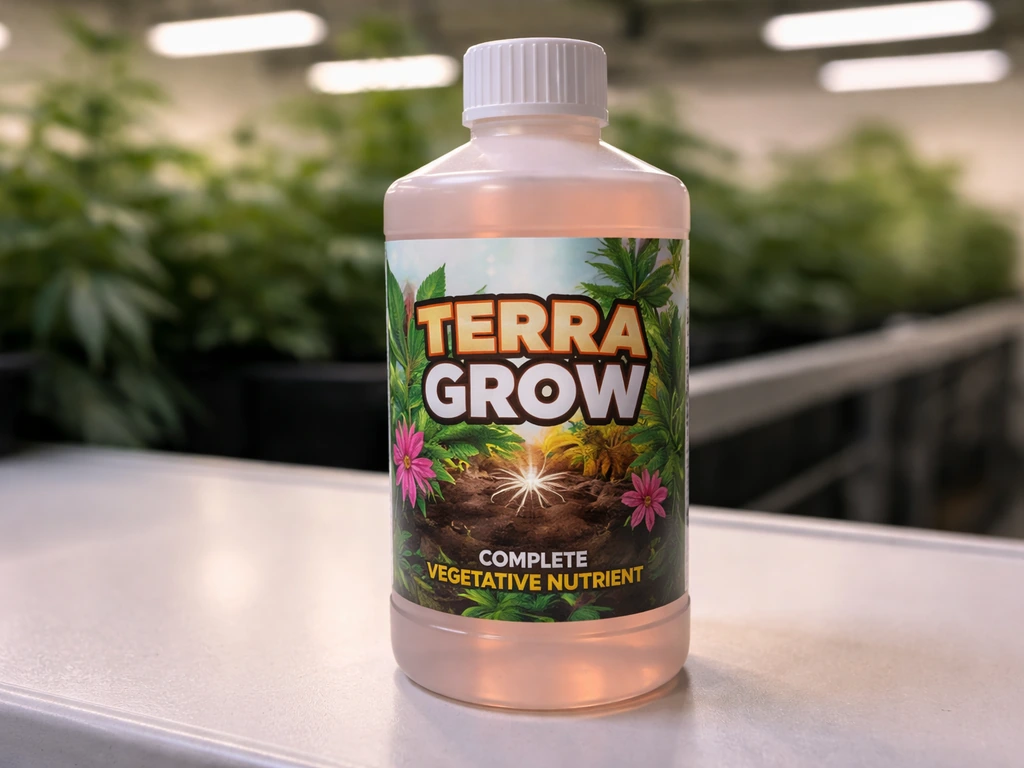
Before dosing anything, confirm you have the right product. "Terra Grow" from Plagron is a single-part base nutrient designed specifically for the grow (vegetative) phase when growing in soil or a soil-like substrate. It is not the same as Plagron's hydro line (Hydro A/B), their organic lines, or any grow-phase additive from another brand that might share a similar name. Check your bottle label for the Plagron logo and the phrase "Base Nutrient" or "complete nutrient for the grow phase." If your bottle says something like "Terra Bloom" or "Terra Vega" from a different manufacturer, or if you are running a two-part hydro system, you are working with different dosage guidelines entirely.
Terra Grow is also specifically a mineral (synthetic) nutrient, which matters because Plagron's own guidance notes that organic products generally don't require strict EC and pH management, but mineral products like Terra Grow absolutely do. So if you have this bottle in hand, you need a pH meter and an EC/TDS meter. No exceptions.
Soil vs. hydro: what changes and what doesn't
Terra Grow is formulated and labeled for soil (and similar substrates like coco mixed with soil). It is not Plagron's recommended product for recirculating hydro systems, where the Hydro A/B line is the proper fit. That said, plenty of growers use Terra Grow in a drain-to-waste coco or amended media setup, and it works well there. The key differences between soil and a more hydro-style setup come down to buffering and frequency.
| Factor | Soil | Drain-to-Waste Coco / Hydro-Style |
|---|---|---|
| pH target (feed water) | 5.8–6.5 | 5.5–6.2 |
| EC buffer from medium | High (soil holds and releases nutrients) | Low (coco/inert media has little buffer) |
| Feeding frequency | Every 2–3 waterings, or as schedule dictates | Every watering once established |
| Flush sensitivity | Less critical between feeds | More critical; salt buildup happens faster |
| Max dose (mL/L) | Up to 5 mL/L (per label) | Up to 5 mL/L, but start lower and watch EC closely |
The practical upshot: in soil, the medium gives you some forgiveness if your EC creeps a little high. In coco or any near-inert setup, that buffer is gone, so small dosing errors show up faster as tip burn or lockout. Adjust your expectations (and your measuring habits) accordingly. If you are wondering what to grow while dialing in your Terra Grow feed for vegetative phase, start with easy, fast-germinating plants that match your schedule Adjust your expectations.
Dosing by stage: seedling through veg and into flower prep
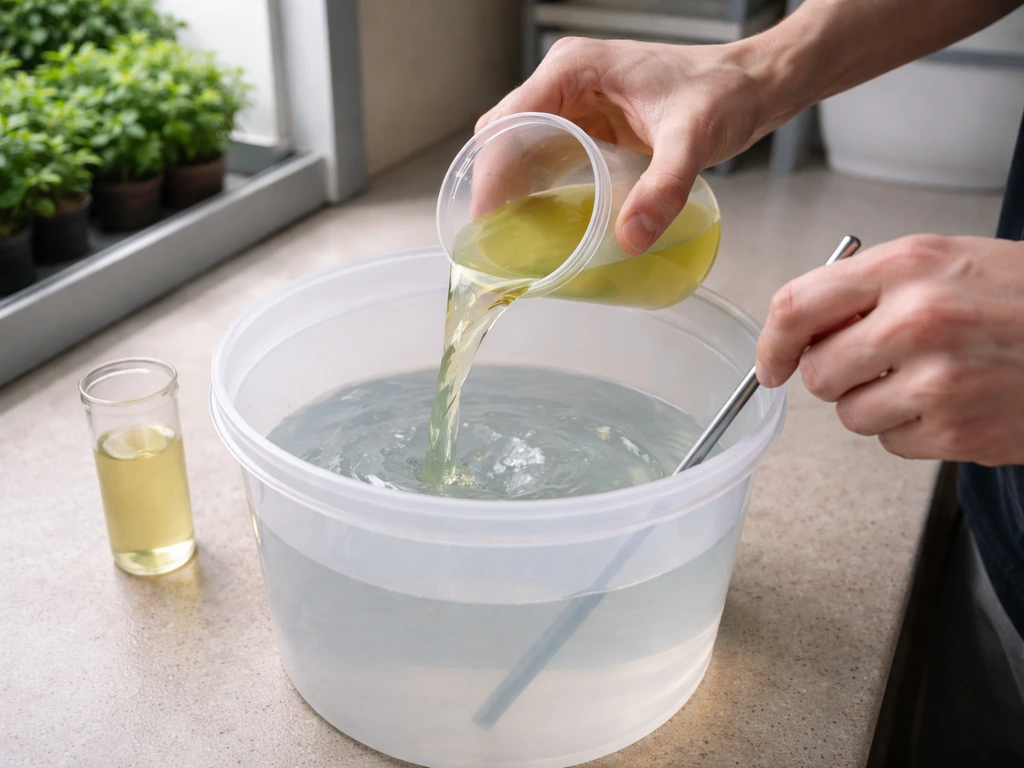
Plagron's official 100% Terra grow schedule gives you week-by-week EC targets that include your tap water's baseline EC (assumed at 0.4 mS/cm in their chart). If your tap water reads differently, adjust: your nutrient-contributed EC equals the target EC minus your tap water EC. Here is how the stages break down.
Seedling and early veg (weeks 1–3)
Target total EC: 0.6 mS/cm. With tap water at 0.4, that means you are only adding around 0.2 mS/cm worth of nutrient, which is a very light feed. At this stage roots are fragile and the plant's demand is low. Start with roughly 1–2 mL/L of Terra Grow rather than the full 5 mL/L. Mix your solution, check EC, and nudge the dose up or down to hit that 0.6 mS/cm target. If your tap water already reads 0.6 or above, plain water (or very lightly supplemented water) may be all you need for the first couple of weeks.
Active veg (weeks 4–7)
This is where you ramp up progressively. The official schedule moves from 1.6 mS/cm at weeks 4–5, to 1.8 at week 6, and 1.9 at week 7. Your dose of Terra Grow increases toward the 5 mL/L maximum during this window. Increase in small steps (0.5–1 mL/L at a time per watering cycle) and always verify EC after mixing rather than just trusting a volume measurement. Watch the plants between each step: healthy new growth, deep green color, and no tip issues means you're in range.
Peak veg and transition (weeks 8–10)
Target EC climbs to 2.0 mS/cm and holds there. At this point you are likely at or near the 5 mL/L maximum. If you are growing photoperiod plants and approaching the flip to flower, week 11 in the schedule is water-only as a transitional flush before switching to a bloom nutrient. If you are growing autoflowers, watch the plants for signs of pre-flowering and begin reducing Terra Grow while transitioning to your bloom product.
| Week | Target EC (mS/cm, incl. tap) | Approx. Terra Grow Dose | Notes |
|---|---|---|---|
| 1–3 | 0.6 | 1–2 mL/L | Light feed; fragile roots |
| 4–5 | 1.6 | 3–4 mL/L | Ramp up gradually |
| 6 | 1.8 | ~4–5 mL/L | Verify EC after mixing |
| 7 | 1.9 | ~5 mL/L | Approaching max dose |
| 8–10 | 2.0 | ~5 mL/L | Peak veg feed |
| 11 | Tap water only | 0 mL/L | Flush/transition week |
These mL/L figures are approximations because your tap water EC and room temperature will shift results. Always measure, never assume.
How to actually mix a feed: step by step
Mixing order and water quality matter more than most growers realize. Getting this wrong causes nutrient precipitation (cloudy solution, locked-out minerals) even before the plant sees it.
- Start with your water at room temperature (roughly 18–22°C). Cold water slows dissolution; very warm water speeds microbial growth. Temperature compensation on your pH meter should be set or noted because pH readings shift with temperature.
- If you use a silica supplement, add it first and stir well before anything else. Silica has a high pH and must be dispersed before adding other nutrients or it will bind them.
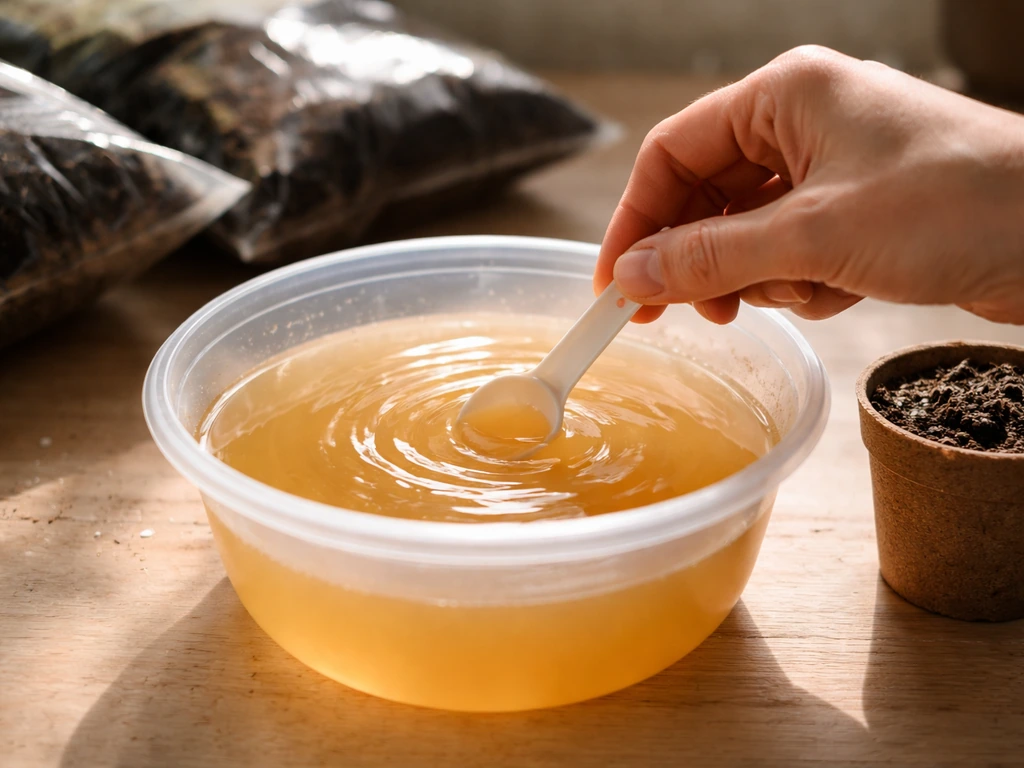
- Add Terra Grow to the water (not water to the concentrate). Measure using a graduated syringe or pipette, not a kitchen spoon. Start with slightly less than your target dose so you have room to fine-tune.
- If you use a cal-mag supplement or any other additive, add it now and stir.
- Stir the solution thoroughly for 30–60 seconds and let it sit for 2–3 minutes.
- Measure EC/TDS. Compare to your stage target. If EC is low, add a small additional amount of Terra Grow and re-measure. If it is already at or above target, do not add more.
- Adjust pH last. For soil use, target 5.8–6.5. For coco/near-inert, target 5.5–6.2. Use a pH up or down solution in small drops, stir, and re-measure. Repeat until stable.
- Re-check EC after pH adjustment, as pH adjusters can slightly shift EC readings.
Water quality is worth a quick note. If your tap water EC is high (above 0.6–0.7 mS/cm on its own) you are already close to or at the early-veg target before adding anything. In that case, either use filtered or RO water and build from a clean baseline, or reduce your Terra Grow dose significantly and re-verify EC. Plagron's official schedule assumes 0.4 mS/cm tap water, so factor in any deviation from that.
Diagnosing and fixing the most common dosage problems
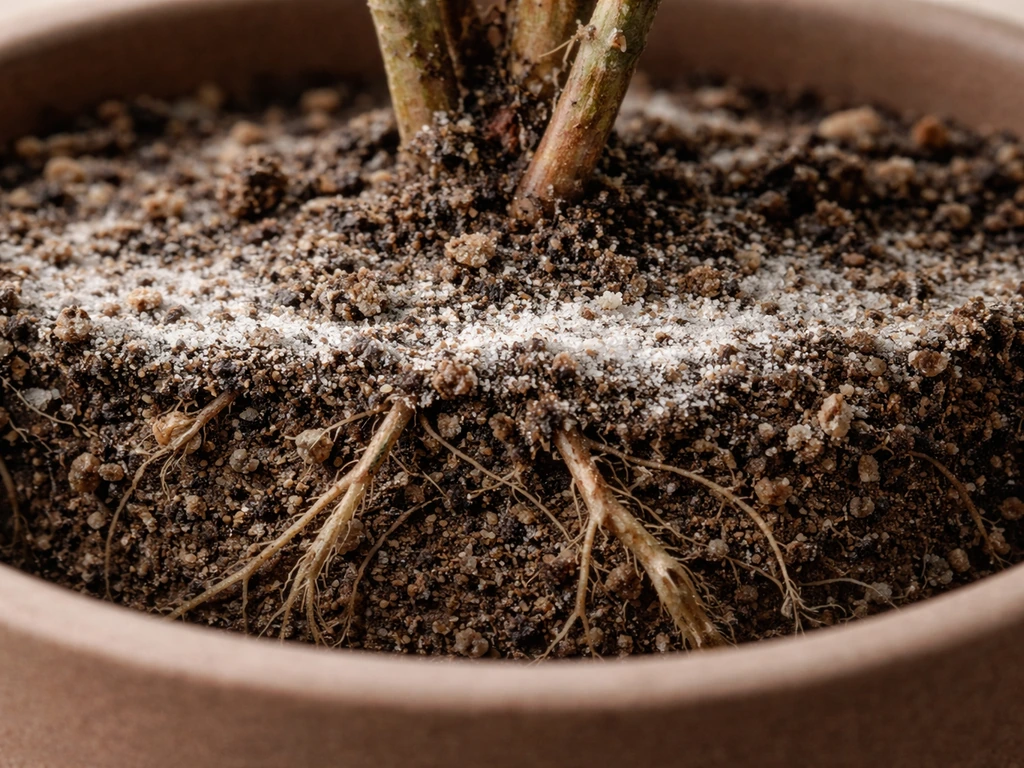
Nutrient burn (overfeeding)
Classic signs are yellowing or brown crispy tips on otherwise healthy leaves, starting at the tips of lower or older fan leaves and progressing inward if it continues. In soil, this can also show up as a white salt crust on the topsoil. The fix is straightforward: check your EC. If it is above the target for the current week, dilute your next feed or give a plain-water watering to let the medium buffer down. Do not add more nutrients until the plant looks stable. Going forward, do not dose by volume alone; always verify with an EC meter before feeding.
Underfeeding and pale or slow growth
If new growth is light green or yellow (especially uniform yellowing across the whole canopy rather than spotty), leaves are small, and internodal spacing is tight but growth is slow, you are likely underfeeding or your EC is too low. Check EC: if it is well below target for the week, step up your dose. Also check that pH is not drifting outside the 5. HORIBA notes that pH measurement and calibration require selecting the right pH buffer group and setting temperature compensation in the pH meter (using temperature measurement and ATC/MTC settings) blank" rel="noopener noreferrer">temperature compensation settings in the pH meter. 5–6. Plagron’s official 100% TERRA grow schedule lists a weekly pH target window of 5.5, 6.5 for Terra Grow blank" rel="noopener noreferrer">5–6. 5 window, because even a correctly dosed feed becomes unavailable if pH is off. Pale growth with correct EC but wrong pH is a lockout problem, not a dosage problem.
pH drift causing apparent deficiencies
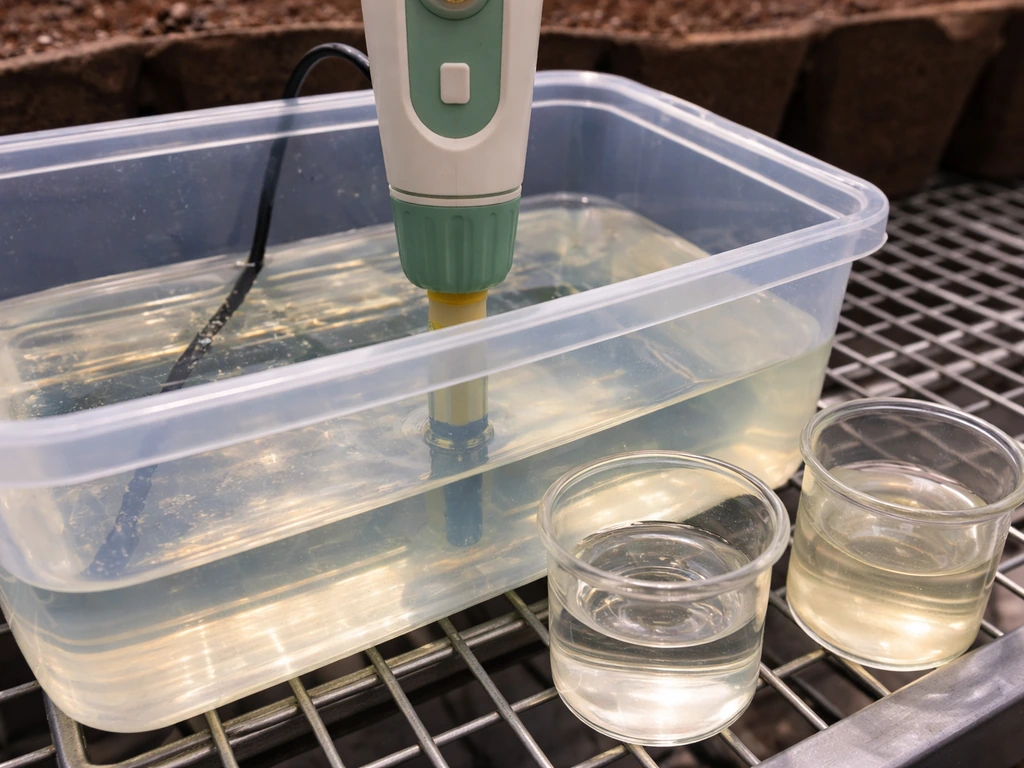
One of the most common mistakes growers make is adjusting pH before adding nutrients, rather than after. Adding Terra Grow changes the pH of your solution, so any pH adjustment you made before adding it is now irrelevant. Always add nutrients first, then adjust pH. If you notice spotty discoloration, purpling on stems, or weird color patterns that do not match a clean deficiency, check your pH meter calibration first. Calibrate with fresh buffer solutions (7.0 and 4.0 are the standard two-point calibration for a nutrient solution range), then re-measure your solution.
Salt buildup in the medium
In soil, if you have been feeding at full strength for multiple weeks without any plain-water flushes, salt accumulation can raise the root-zone EC above what you are delivering in your feed water. Signs include progressively worsening tip burn even though your feed EC looks correct, or sudden wilting that does not respond to watering. Flush with plain pH-adjusted water (roughly 3x the pot volume) and measure runoff EC. If runoff EC is significantly higher than your feed EC, flush until runoff EC is close to feed EC before resuming normal feeding.
Your application schedule: how often, runoff, and system type
Drain-to-waste (most common for soil and coco)
In a drain-to-waste setup you water until you get 10–20% runoff from the bottom of the pot. This runoff is discarded. Checking the EC and pH of runoff is extremely useful: runoff EC should be within roughly 0.3–0.5 mS/cm of your feed EC. If runoff EC is much higher, you have salt buildup and need a flush. If it is much lower, the medium may be depleted. In soil, a common cadence is feeding every other watering (one nutrient feed, one plain pH-adjusted water), but this varies with plant size, pot size, ambient temperature, and growth rate. In coco, most growers feed with nutrients every watering once the plant is established.
Recirculating systems
As noted earlier, Terra Grow is not specifically designed for recirculating hydro systems, and Plagron's Hydro A/B line is the appropriate product for those setups. If you are trying to do this in the spirit of Valerian grow best harry potter, follow the same EC and pH discipline rather than guessing Terra Grow. If you are running recirculation with Terra Grow by choice, test your reservoir EC and pH daily. Reservoir EC drifts as plants consume nutrients and water evaporates. Top off with plain water when level drops (to compensate for evaporation-driven EC rise), and do full reservoir changes every 7–10 days to prevent salt and pathogen buildup. Never just keep topping up with fresh nutrient solution without knowing your current EC, or you will overfeed progressively.
Flush week and transition
Following the Plagron schedule, week 11 (or whenever you approach the flower flip) is a water-only week. This is not optional if you want a clean transition. Give plain pH-adjusted water and let the medium clear before switching nutrient products. This also doubles as a diagnostic: if plants look lush and healthy through the flush week, your feeding program was calibrated correctly.
The tools you actually need (and how to use them)
You do not need a lot of gear, but these three things are non-negotiable for dialing in Terra Grow dosage correctly. If you are also growing valerian, it will generally grow best when you match the soil, temperature, and watering it prefers valerian grow best. If you want the exact floranova grow dosage for your stage, use EC readings to translate the target into the right amount for your tap water Terra Grow dosage correctly.
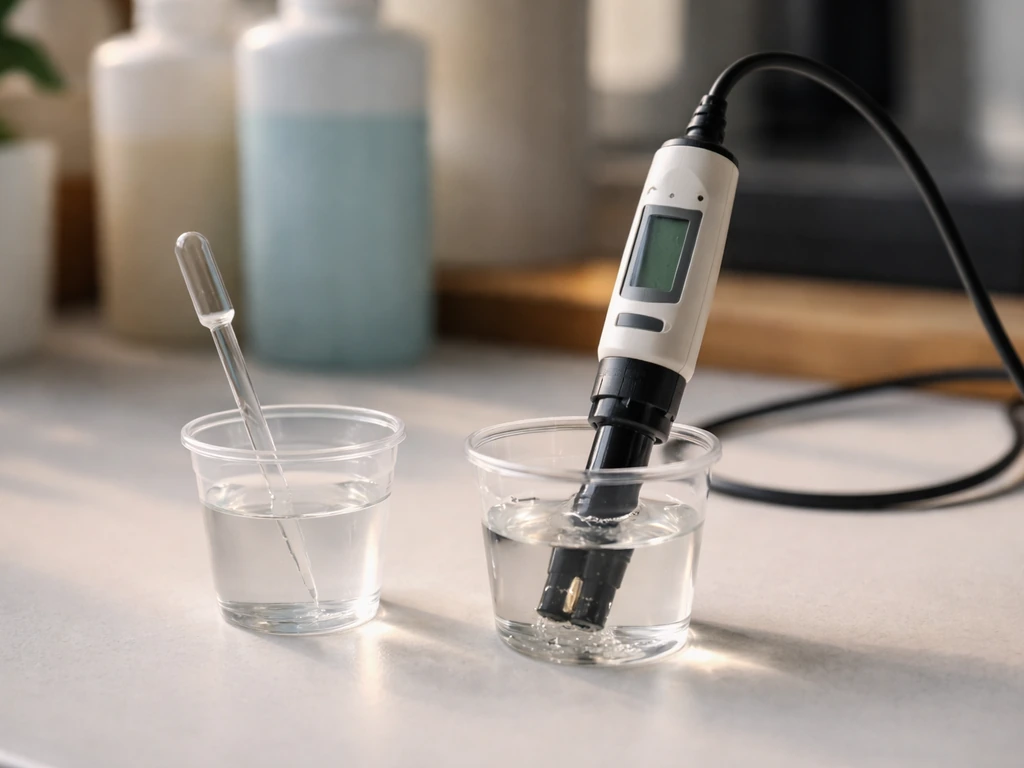
- EC/TDS meter: Measures the total dissolved solids in your nutrient solution. EC (mS/cm) is what Plagron's schedule uses. If your meter reads in TDS (ppm), use the 500 scale (1 mS/cm = approximately 500 ppm on the 500 scale, or 700 ppm on the 700 scale; check which scale your meter uses). Calibrate with a known EC calibration solution every few weeks. Rinse the probe after each use.
- pH meter: More important than any dosage chart. Calibrate with a two-point calibration using pH 7.0 and pH 4.0 buffers before each grow, and recheck calibration weekly. Store the probe in storage solution (not distilled water, which destroys the sensing membrane). If your readings seem unstable, recalibrate before troubleshooting anything else. Look for a meter with automatic temperature compensation (ATC) so temperature shifts in your mixing water do not skew readings.
- Graduated syringe or pipette (1–10 mL range): A 5 mL or 10 mL syringe lets you measure small volumes of Terra Grow accurately. Pouring from the bottle cap introduces major dosing errors, especially at the 1–2 mL/L range needed in early weeks.
Calculator workflow for each feed
- Decide your batch size (e.g., 10 litres for a 2-pot setup).
- Look up your target EC for the current week from the schedule.
- Measure your tap water EC. Subtract from target EC to get the nutrient EC you need to add.
- Start with a conservative Terra Grow dose (e.g., 3 mL/L if you are in week 5), multiply by batch size (3 mL x 10 = 30 mL total), and add to water.
- Measure EC of the mixed solution. Adjust Terra Grow dose up or down by 0.5 mL/L increments until you hit the target EC.
- Adjust pH to target range (5.8–6.5 for soil; 5.5–6.2 for coco-style).
- Re-check EC, write down the final dose and EC reading, and feed.
- After feeding, check runoff EC and pH if in a drain-to-waste setup. Log the results. After 2–3 feeds with consistent results, you have your reliable dose locked in for that week.
Plagron also offers a Grow Schedule Calculator on their website that lets you input your grow style and get a week-by-week breakdown with EC targets, which is a useful cross-reference against the manual approach above. It is worth running through it once to sanity-check your schedule, especially if you are running a longer veg period than the standard 10-week chart assumes. Compared to other nutrient lines covered on this site, such as FloraNova Grow, Terra Grow uses a single-bottle simplicity rather than a two-part system, which makes it easier to dial in but also means you have less flexibility to adjust individual nutrient ratios independently. For most home soil growers, that trade-off leans clearly in Terra Grow's favor.
FAQ
My tap water EC is higher than 0.4 mS/cm, how do I adjust terra grow dosage?
If your tap water EC is high, you should reduce Terra Grow dose because Plagron’s targets assume a baseline of about 0.4 mS/cm. Use the rule of thumb: nutrient EC contribution equals (target total EC) minus (tap water EC), then verify by measuring the final solution EC after mixing.
Can I start terra grow at less than 5 mL per litre and still hit the right veg EC?
Yes, you can start lower than 5 mL/L, but you should not guess your way to the target. Add an initial small dose (for early veg, often 1 to 2 mL/L), mix thoroughly, measure EC, then step up gradually in small increments while watching new growth and tip condition.
Do I really need an EC and pH meter for Terra Grow, or can I dose by volume?
For Terra Grow, EC and pH control apply because it is a mineral feed. You should use an EC/TDS meter and a calibrated pH meter, and adjust pH after nutrients are added (not before), since adding nutrient will change pH.
How do I tell whether problems are from pH drift versus terra grow dosage?
pH drift can make a correct EC look wrong. If new growth is pale but EC is on target, recheck pH of the mixed feed and, if possible, the pH of runoff. Also confirm your pH meter is calibrated with fresh buffer solutions (around 7.0 and 4.0) before chasing dosage changes.
What should I do if I get tip burn but my feed EC matches the recommended target?
If you are seeing tip burn that worsens even when your mixed feed EC matches the schedule, suspect root-zone salt buildup. Do a plain-water flush with pH-adjusted water (about 3x pot volume), then measure runoff EC and resume feeding only when runoff EC is close to feed EC.
How often should I feed with terra grow in soil versus coco?
In soil, feeding cadence matters, and too-frequent full-strength dosing can accumulate salts. A common approach is nutrient feed on one watering, plain pH-adjusted water on the next, then adjust based on plant size and how quickly the medium dries. In coco or near-inert mixes, more frequent feeding is typical once established.
Is checking runoff EC worth it, and what does it tell me?
Runoff EC is a quick diagnostic for whether the medium is accumulating salts or getting depleted. A useful check is that runoff EC should be roughly close to feed EC, typically within about 0.3 to 0.5 mS/cm. Higher runoff EC suggests you need a flush, much lower suggests the medium is running out.
Why do some people get pH issues even when they correct pH in the right range?
Do not adjust pH before adding Terra Grow. Add the nutrient first, mix well, then pH-correct the final solution to the 5.5 to 6.5 target range, otherwise your earlier pH adjustment will be invalidated by the nutrient addition.
I’m using coco with Terra Grow, how does dosage dialing differ from soil?
Terra Grow can be used in drain-to-waste coco or amended media, but it behaves less forgivingly than true soil buffering. Small dosing errors show up faster, so increase cautiously, verify EC after mixing every time, and consider more frequent EC checks during the first couple of weeks.
Do I have to do the water-only week before switching from veg to bloom nutrients?
During the transition toward flower (for photoperiods), schedule guidance commonly calls for a water-only week before switching nutrient products. If you keep feeding the base nutrient through the flip, you can end up carrying too much nitrogen and salts into the transition. Use the flush week as both transition and calibration.
If I use terra grow in a recirculating system anyway, what reservoir practices prevent overfeeding?
In recirculating hydro, Terra Grow is not the designed option, but if you choose to run it anyway, treat it like a controlled reservoir system: measure reservoir EC and pH daily, top off with plain water when level drops (to avoid EC creep), and fully change the reservoir about every 7 to 10 days.
What causes cloudy solution or nutrient precipitation with terra grow, and how do I prevent it?
Yes, precipitation is a dosing and mixing-quality issue. Mix water and nutrients in the correct order (as instructed on the bottle), stir thoroughly, and recheck clarity. If the solution turns cloudy or you see sediment, stop and remake the batch, then re-measure EC before feeding.